
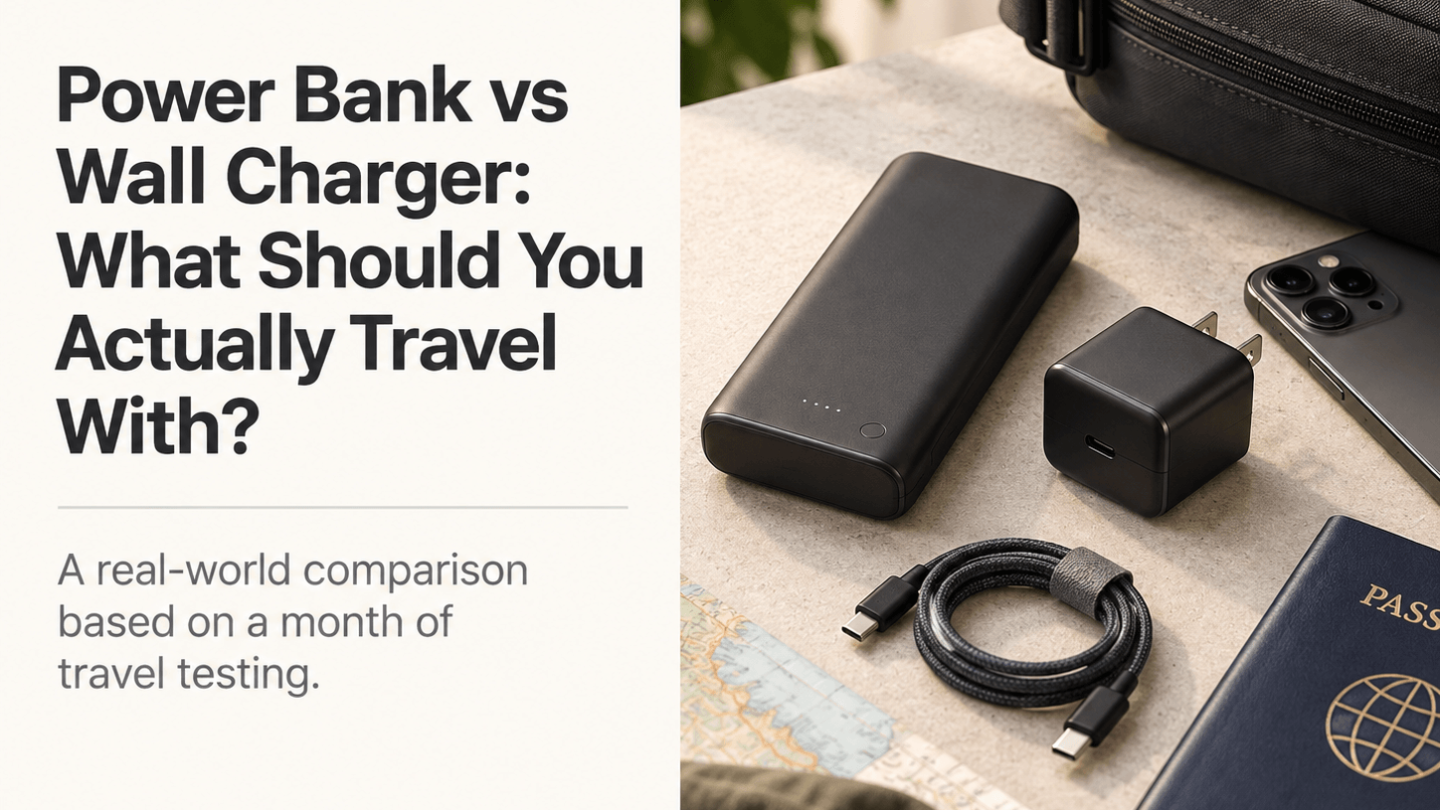
Most travel packing advice tells you to bring both. That is fine if you have unlimited bag space and no interest in weight.
For everyone else, these two categories solve overlapping problems and one of them usually earns its place more than the other. A power bank gives you power away from an outlet. A fast wall charger gives you power quickly when you find one.
Those are different jobs and the right answer depends on how you travel rather than on which device is objectively better.
We tested both categories across a month of travel, including flights, hotel rooms, day trips, and one long layover. Here is how they compare.
Quick Comparison
| Factor | Power Bank | Wall Charger |
| Works without an outlet | Yes | No |
| Charging speed | Limited by bank output | Faster, often much faster |
| Weight | 220g to 450g typical | Under 100g typical |
| Airline rules | Carry on only, watt hour capped | No restrictions |
| Charges multiple devices | Usually one or two | Often three or four |
| Runs out | Yes, needs recharging itself | No, unlimited while plugged in |
| Best for | Day trips and long transit | Hotel rooms and overnight |
Charging Speed
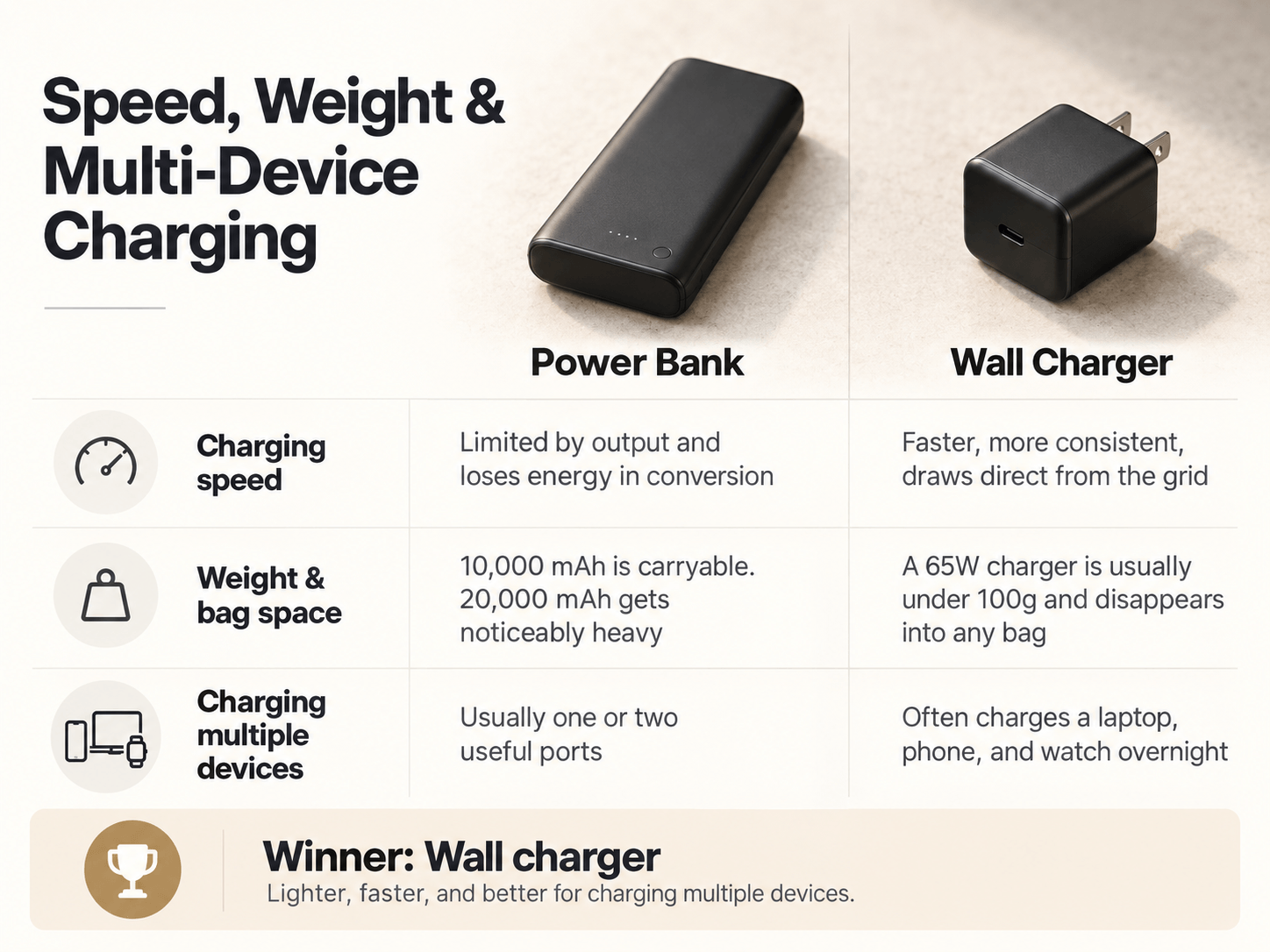
A wall charger wins this without much of a contest.
A modern 65W wall charger refills a phone at close to its maximum rate and can charge a laptop at the same time. Most power banks cap well below that, and the ones that do not are heavy.
Power banks also lose energy in conversion. Across our testing, real world delivery landed between roughly sixty and eighty five percent of printed capacity, with losses going to voltage conversion, heat, and the battery’s own protection circuit.
A wall charger loses nothing. It pulls from the grid and delivers.
Winner: Wall charger
Faster, more consistent, and no conversion losses.
Working Without an Outlet
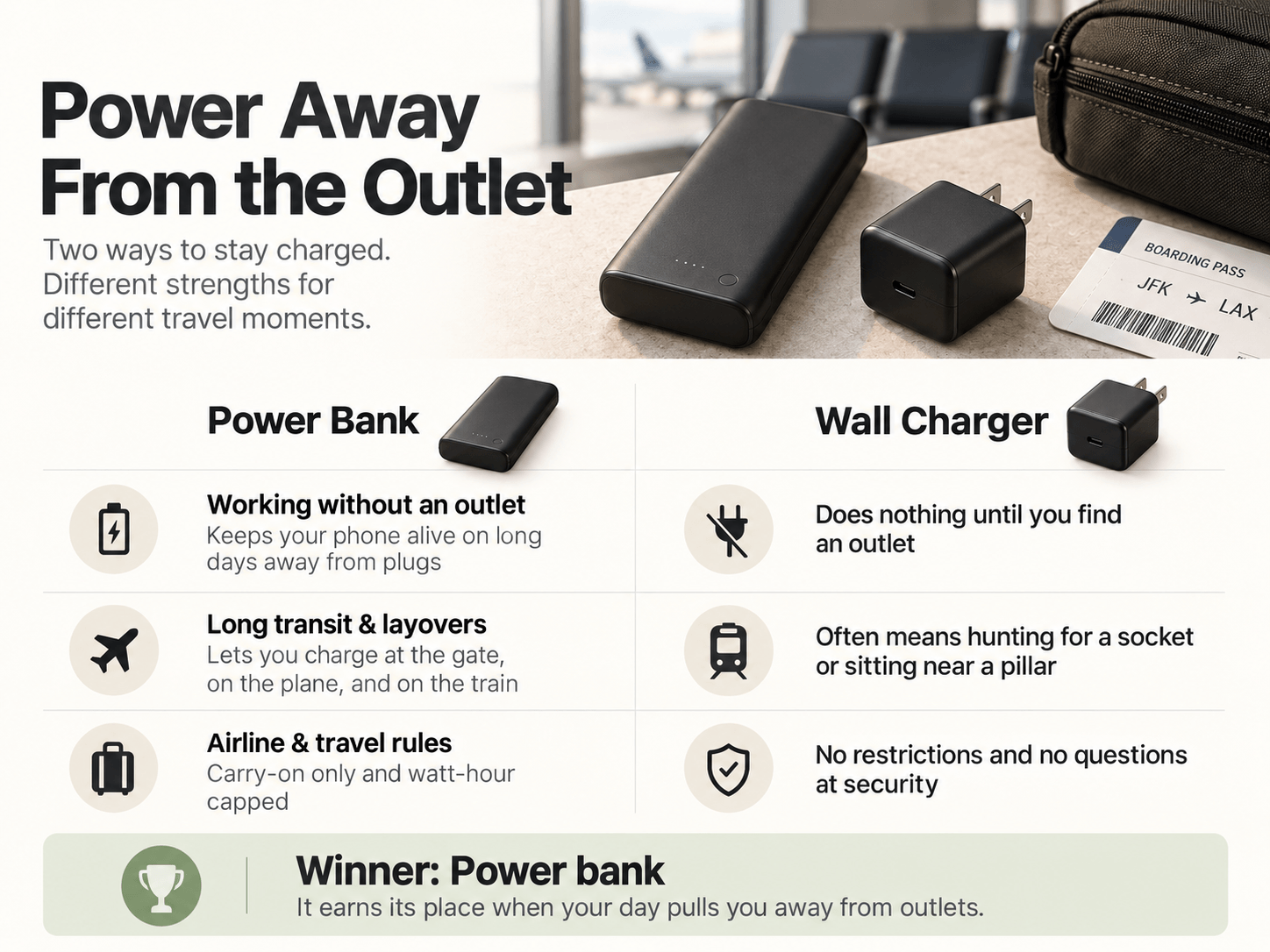
This is the entire reason power banks exist and no wall charger can compete.
On a day of walking a city with heavy map and camera use, a phone will not survive to dinner. A wall charger sitting in your hotel room does nothing about that.
A 10,000 mAh power bank gave us two full phone charges in testing, which covers a long day comfortably. A 20,000 mAh bank gave us four.
Winner: Power bank
The only one of the two that works where there is no plug.
Weight and Bag Space
A 65W wall charger with folding pins weighs under 100 grams and disappears into any bag.
A 10,000 mAh power bank is usually under 220 grams. A 20,000 mAh bank runs 350 to 450 grams and is genuinely noticeable in a jacket pocket.
Our practical view after this test is that most travelers are better served by a smaller bank they carry every day than a large one that stays in the hotel because it is heavy. Two charges you have with you beats four charges you left behind.
Winner: Wall charger
Lighter by a wide margin, and no capacity to make.
Airline and Security Rules
Wall chargers have no restrictions. Pack them anywhere.
Power banks go in carry on only, never in checked baggage, and that is firm on essentially every airline.
The cap is set in watt hours, not mAh. Most airlines allow up to 100 Wh without approval. To convert, multiply mAh by cell voltage and divide by 1000. A 20,000 mAh bank at 3.7 volts is about 74 Wh, comfortably under.
Reputable brands print the watt hour rating on the unit. Anker and Belkin both do this clearly. Banks without that number printed anywhere invite questions at security and are sometimes taken.
Winner: Wall charger
Nothing to check, nothing to explain, nothing to lose.
Charging Multiple Devices
Modern wall chargers commonly offer three or four ports and can split power intelligently between a laptop, a phone, and a watch at once.
Most power banks offer one or two useful ports, and output drops sharply when both are in use.
For a hotel room at the end of a day with four devices to refill overnight, this is not close.
Winner: Wall charger
More ports, more total power, better for overnight top ups.
Long Transit and Layovers
Airports have outlets, but they are contested and they are rarely near your seat.
A power bank means you charge from your gate seat, on the plane, and on the train afterward without hunting for a wall.
A wall charger means you sit on the floor near a pillar for forty minutes.
For anything over about six hours of transit, the bank earns its weight.
Winner: Power bank
Freedom from finding and defending an outlet.
International Travel
A wall charger needs the right plug shape for the country you are in, which means an adapter or a travel model with swappable pins.
A power bank works identically everywhere, since you charge it whenever you have any outlet and use it anywhere.
That said, you still need a wall charger of some kind to refill the bank, so this is a partial point rather than a full one.
Winner: Power bank
Plug shape does not affect it once it is charged.
Which One Should You Choose?
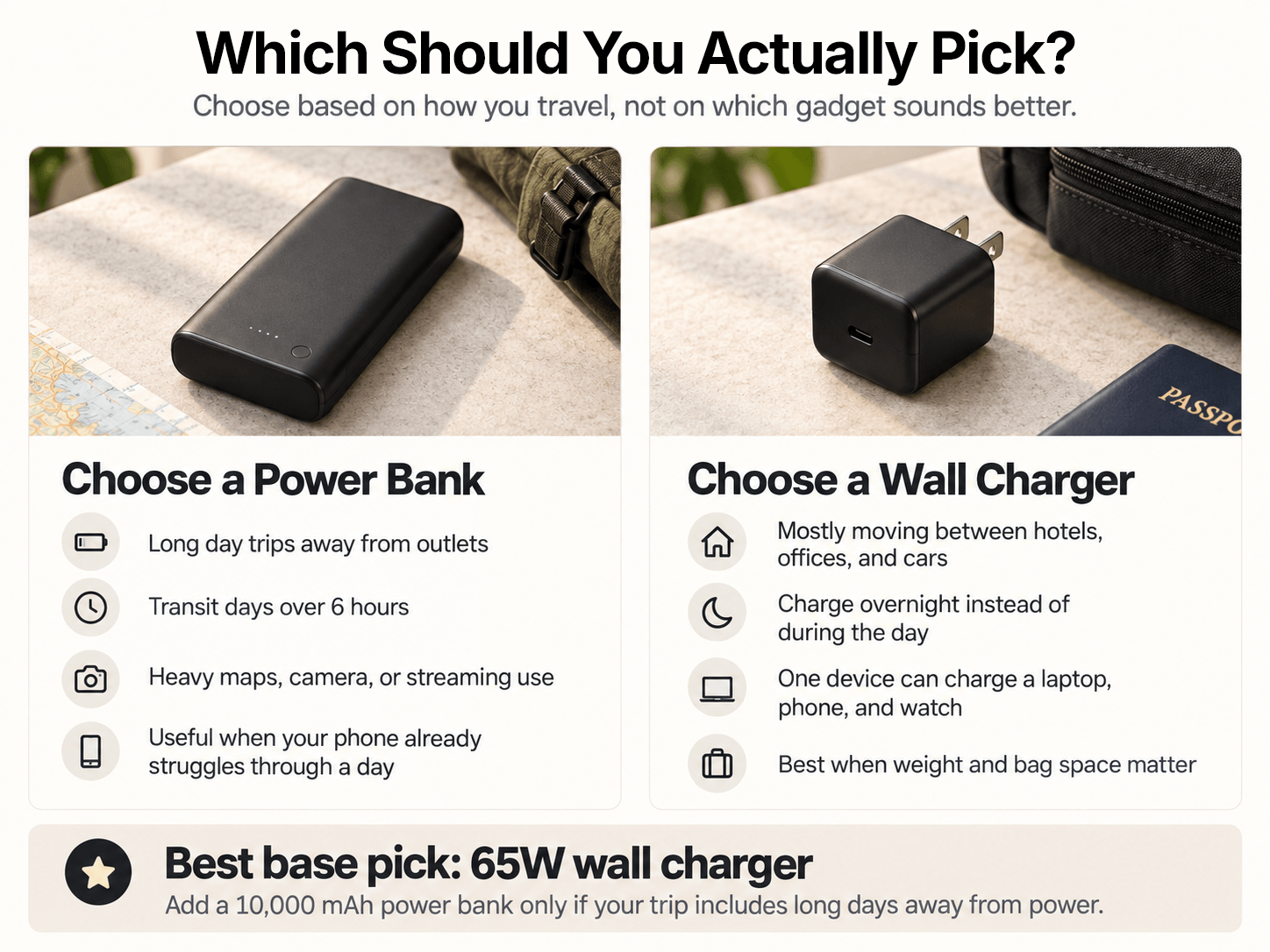
Choose a power bank if:
- You take long day trips away from outlets.
- Your transit days run over six hours.
- You use maps, cameras, and streaming heavily while out.
- You travel in places where outlets are scarce or contested.
- Your phone battery already struggles through a normal day.
Choose a wall charger if:
- You are mostly moving between hotels, offices, and cars.
- You charge overnight rather than during the day.
- You carry a laptop and want one device to charge everything.
- Weight and bag space are your main constraints.
- Your trips are short and outlets are always nearby.
Final Verdict
If you only take one, take the wall charger. It is lighter, faster, charges more devices, has no airline restrictions, and never runs out. For business travel, short trips, and anything where you sleep near an outlet every night, it covers the job completely.
The power bank earns its place the moment your day pulls you away from outlets for eight hours or more. Long sightseeing days, long transit, festivals, hikes, and anywhere the plug is not where you are.
The honest answer for most travelers is a 65W wall charger as the base, and a 10,000 mAh power bank added only if your trip actually includes long days away from power.
Carrying a heavy bank you never open is the most common packing mistake in this category.