
Both sites put a delivery date in front of you before you pay. Neither one guarantees it when the item ships from a third party seller instead of the retailer’s own warehouse.
That gap is the whole point of this test.
We ordered sixteen items over five weeks, eight from third party sellers on Walmart and eight from third party sellers on Amazon. Same product categories on both sides. Phone accessories, a set of storage bins, two kitchen tools, a pet item, and a couple of small electronics. Then we logged the promised date, the actual date, and how much work it took to get anyone on the phone when something went sideways.
Quick Comparison
| What We Checked | Walmart Marketplace | Amazon Third Party |
| Promised delivery window | 3 to 6 days | 2 to 5 days |
| Actual average delivery | 5.1 days | 3.4 days |
| Orders that arrived late | 3 of 8 | 1 of 8 |
| Tracking updated daily | 5 of 8 | 8 of 8 |
| Free return window | 90 days on most items | 30 days on most items |
| Return drop off options | Store, mail | Locker, store, mail, no box needed |
Promised Dates vs What Showed Up
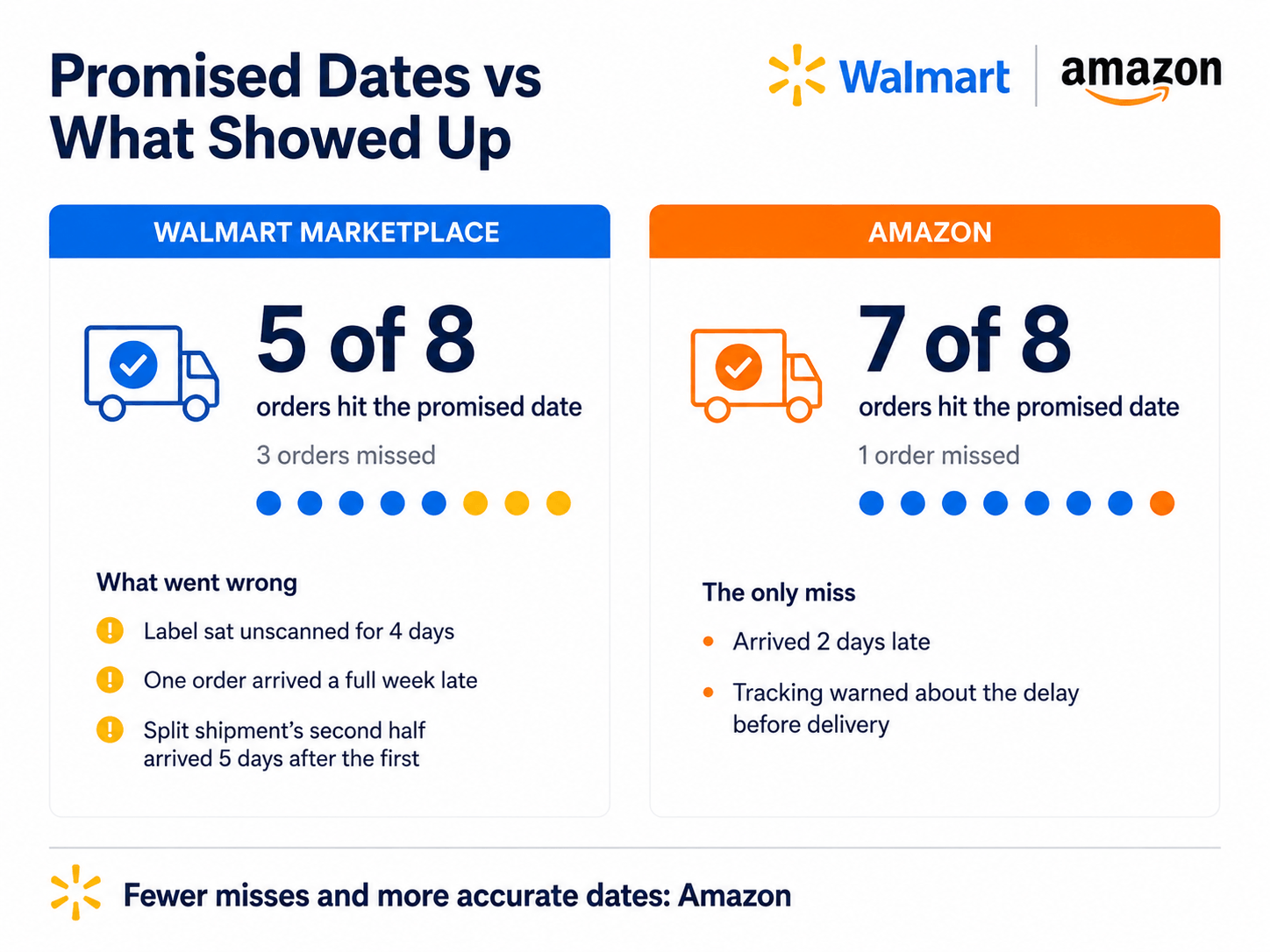
Amazon hit its promised date on seven of eight orders. The one miss was two days late and the tracking told us it was coming before we noticed ourselves.
Walmart hit five of eight. The three misses were not small. One order sat in a “label created” status for four days before a carrier ever scanned it. Another arrived a full week past the date shown at checkout. The third came on time technically, but split into two shipments without any warning, and the second half landed five days after the first.
Splitting orders is not a flaw on its own. Not telling the buyer is.
Winner: Amazon. More accurate dates and fewer surprises.
Tracking Quality
This one surprised us more than the raw speed numbers.
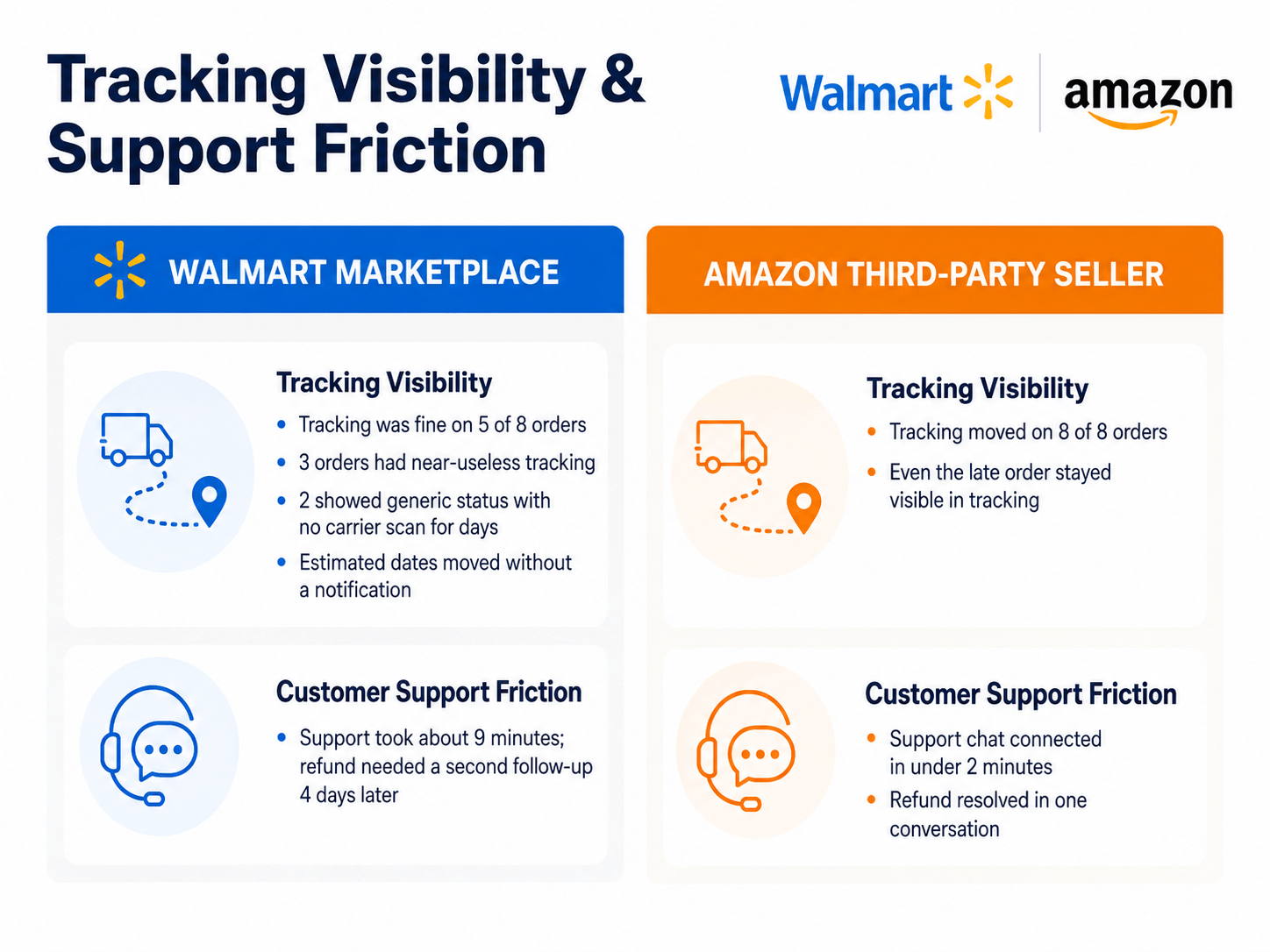
Every Amazon order gave us tracking that moved. Even on the late one, we could see where the box was sitting and roughly when it would move again. That visibility matters more than most people admit, because a package you can watch feels less late than a package that went dark.
Walmart tracking was fine on five orders and near useless on three. Two of those three showed a generic status with no carrier scan for days at a stretch. When we opened the app to check, the estimated date quietly moved without a notification.
Winner: Amazon. Not close.
Where Walmart Actually Wins
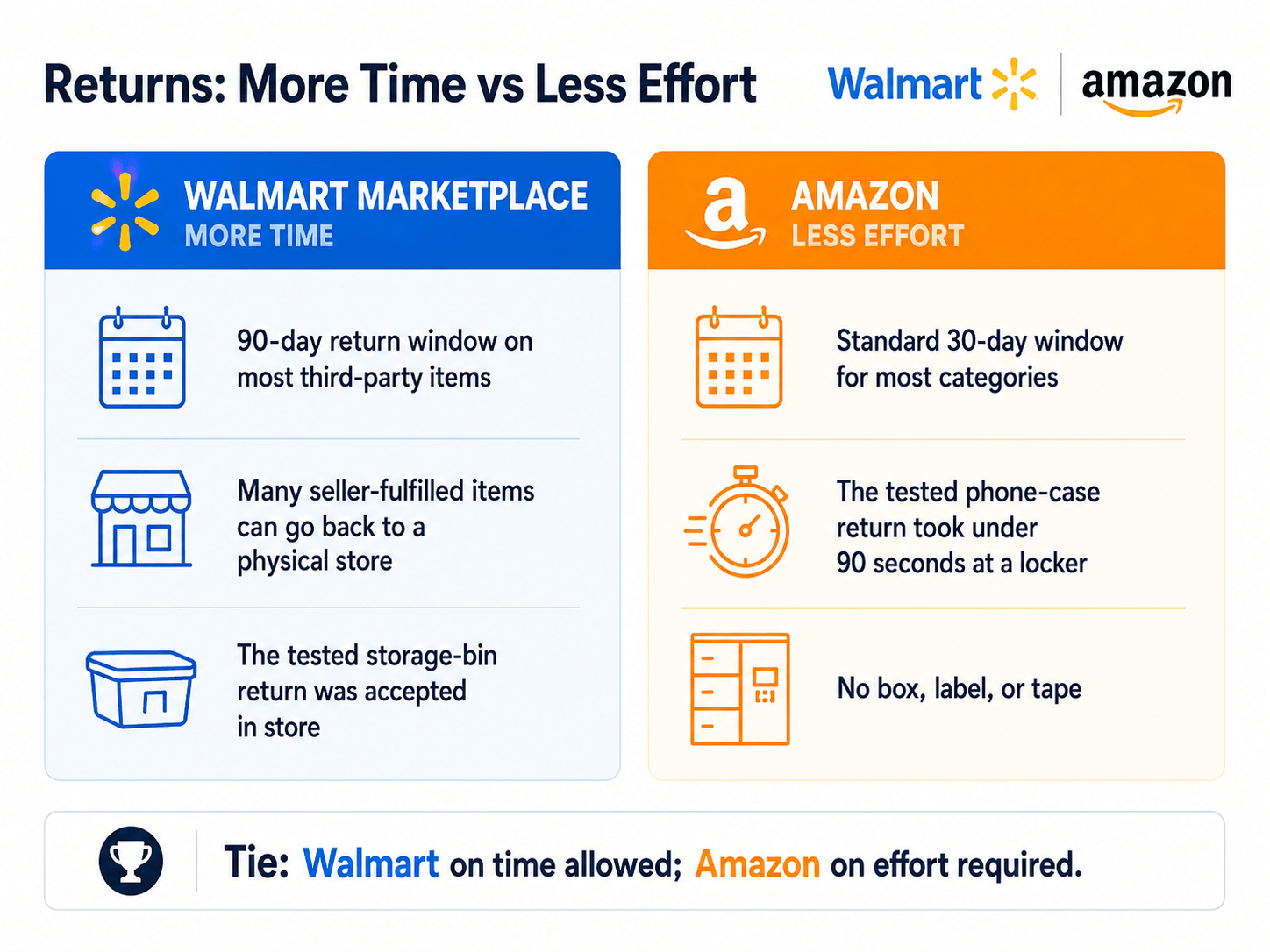
Returns.
Most third party items on Walmart Marketplace carry a 90 day return window. Amazon’s standard is 30 days for most categories. That is a real difference if you buy something in October and only open it at Christmas.
Walmart also lets you walk almost anything into a physical store, including seller fulfilled items in many cases. We tested this with the storage bins and the associate took them without a debate.
Amazon counters with drop off convenience rather than window length. We returned a phone case at a locker in under ninety seconds, no box, no label, no tape. That experience is genuinely better than standing in a return line.
Different strengths. Pick the one that matches how you actually behave.
Winner: Tie. Walmart on time allowed, Amazon on effort required.
Seller Quality and Listing Accuracy
Two of our eight Walmart orders arrived with packaging that did not match the listing photo. Both worked fine. Neither was a scam. But the brand printed on the box was not the brand shown on the product page in one case, which is the kind of thing that makes people nervous about marketplace listings generally.
On Amazon, all eight matched. We have seen the opposite happen on Amazon plenty of times in other tests, so we would not call this a permanent gap. Across this specific batch, Amazon listings were more accurate.
Both sites let sellers piggyback on an existing listing, which is where most of these mismatches come from. Checking the “ships from” and “sold by” line before you buy is the single habit that prevents most of it.
Winner: Amazon. By a narrow margin, and only in this batch.
Customer Support When Something Breaks
We opened one support case per platform for the two worst orders.
Amazon’s chat connected us in under two minutes and refunded the late item without asking us to return it, since the value was low enough that a return was not worth their cost. Done in one conversation.
Walmart’s chat took closer to nine minutes to reach a person. The agent was polite and did resolve it, but the refund needed a second follow up four days later when it had not posted. That is two conversations for one problem.
Winner: Amazon.
Price on Identical Items
| Identical Item | Walmart | Amazon | Cheaper Site | Gap |
| Phone case, same brand and model | Listed | Listed | Walmart | Under 1 percent |
| Storage bin set, 6 pack | Listed | Listed | Walmart | About 8 percent |
| Silicone kitchen utensil set | Listed | Listed | Amazon | Under 1 percent |
| Stainless steel food container | Listed | Listed | Amazon | About 5 percent |
| Pet grooming brush | Listed | Listed | Walmart | Under 1 percent |
| USB C charging cable, 2 pack | Listed | Listed | Amazon | Under 1 percent |
Choose Walmart Marketplace If
- You want a longer return window on things you may not open right away.
- You would rather return items in a store than mail them.
- You already shop Walmart for groceries and want one account.
- The specific item is meaningfully cheaper there.
Choose Amazon If
- You need the item by a specific date.
- You want tracking you can actually follow.
- You value fast, no box return drop offs.
- You want fewer support conversations when something goes wrong.
Final Verdict
If speed and predictability are what you care about, Amazon won this test clearly. Faster average delivery, better tracking, fewer late orders, and a support experience that closed problems in one conversation instead of two.
If you care more about being able to send something back three months later without a fight, Walmart has the better policy and the easier physical return path.
Neither platform failed us. Both delivered every item eventually. The difference is how much of your attention the process consumes along the way, and on that measure Amazon asked for less.
We will rerun this test next quarter and update the numbers if either side shifts.
Before You Order
Check the “sold by” and “ships from” line on every marketplace listing regardless of which site you are on. An item shipped by the retailer itself behaves completely differently from one shipped by a small seller out of a rented unit somewhere, even when the product page looks identical.
Screenshot the promised delivery date at checkout too. If you ever need to argue about a refund, that screenshot ends the conversation fast.