

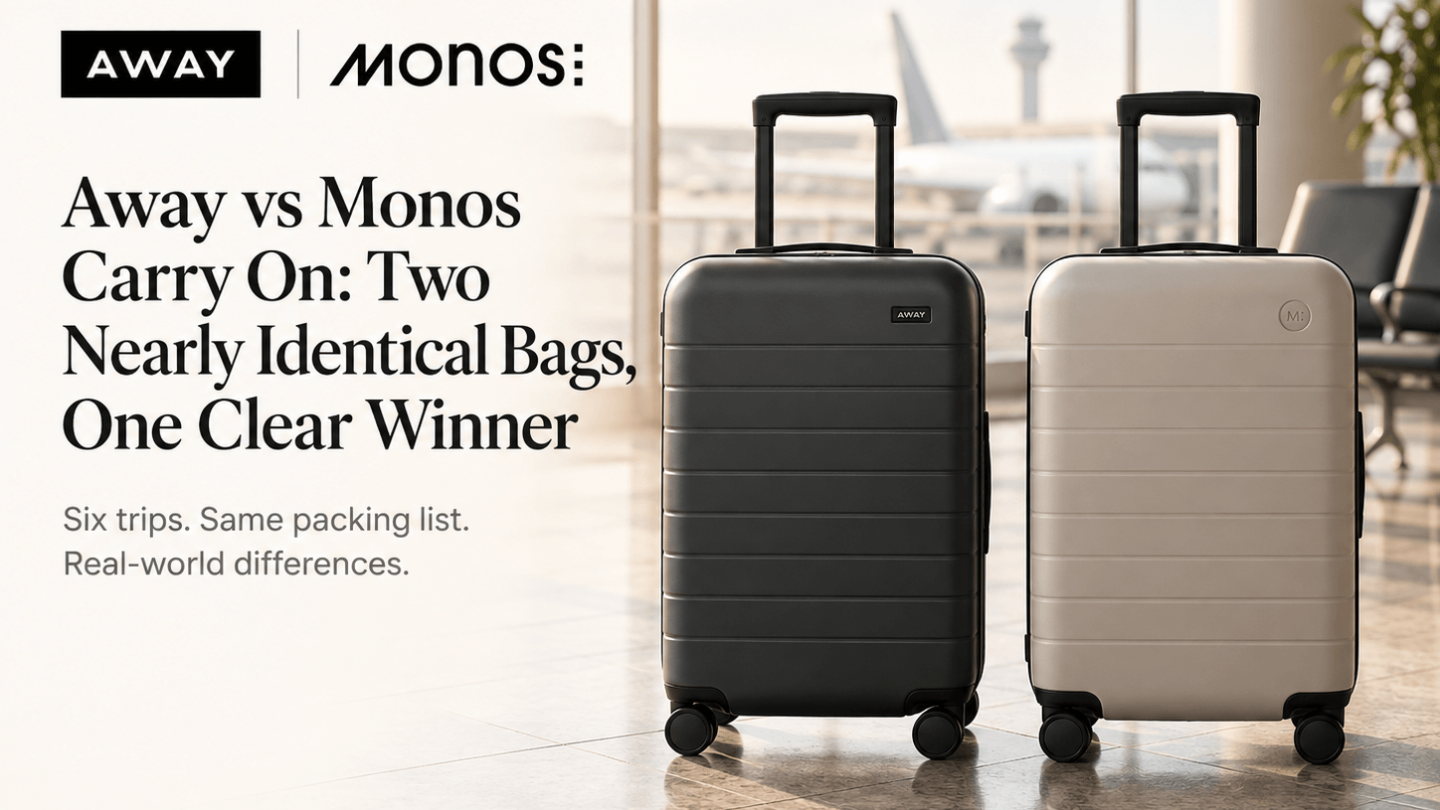
Put the Away carry on and the Monos carry on next to each other and you would struggle to tell them apart in a photo.
Same polycarbonate hard shell. Same four spinner wheels. Same telescoping aluminium handle. Same interior layout, with a compression panel on one side and a zippered mesh divider on the other. Both sized to standard domestic carry on dimensions. Both sold direct to consumers at a similar price. Both with a limited lifetime warranty on the shell.
That is the point of this comparison. When two products are this closely matched on paper, the spec sheet stops being useful and only real use separates them.
We flew both on six trips over four months, packed with the same list every single time. Here is where two nearly identical bags actually diverged.
Where They Are Identical
| Specification | Away | Monos |
| Shell material | Polycarbonate | Polycarbonate |
| Wheels | 4 spinner | 4 spinner |
| Handle | Telescoping aluminium | Telescoping aluminium |
| Interior layout | Compression panel plus mesh divider | Compression panel plus mesh divider |
| Carry on sizing | Standard domestic | Standard domestic |
| Warranty type | Limited lifetime on shell | Limited lifetime on shell |
| Airline damage covered | Typically excluded | Typically excluded |
Seven specifications. Seven matches. Nothing here helps you choose.
Where They Actually Differ
| Difference | Away | Monos |
| Packing capacity | Slightly more | Slightly less |
| Shell finish | Marks more visibly | Matte, hides marks |
| Wheel durability | One failed at flight 5 | All four intact |
| Rolling behaviour | Pulled to one side | Straight and quieter |
| Dust cover | Not included | Included |
| Price | Higher | Lower |
Six differences. That is the entire decision.
Difference 1: Packing Capacity
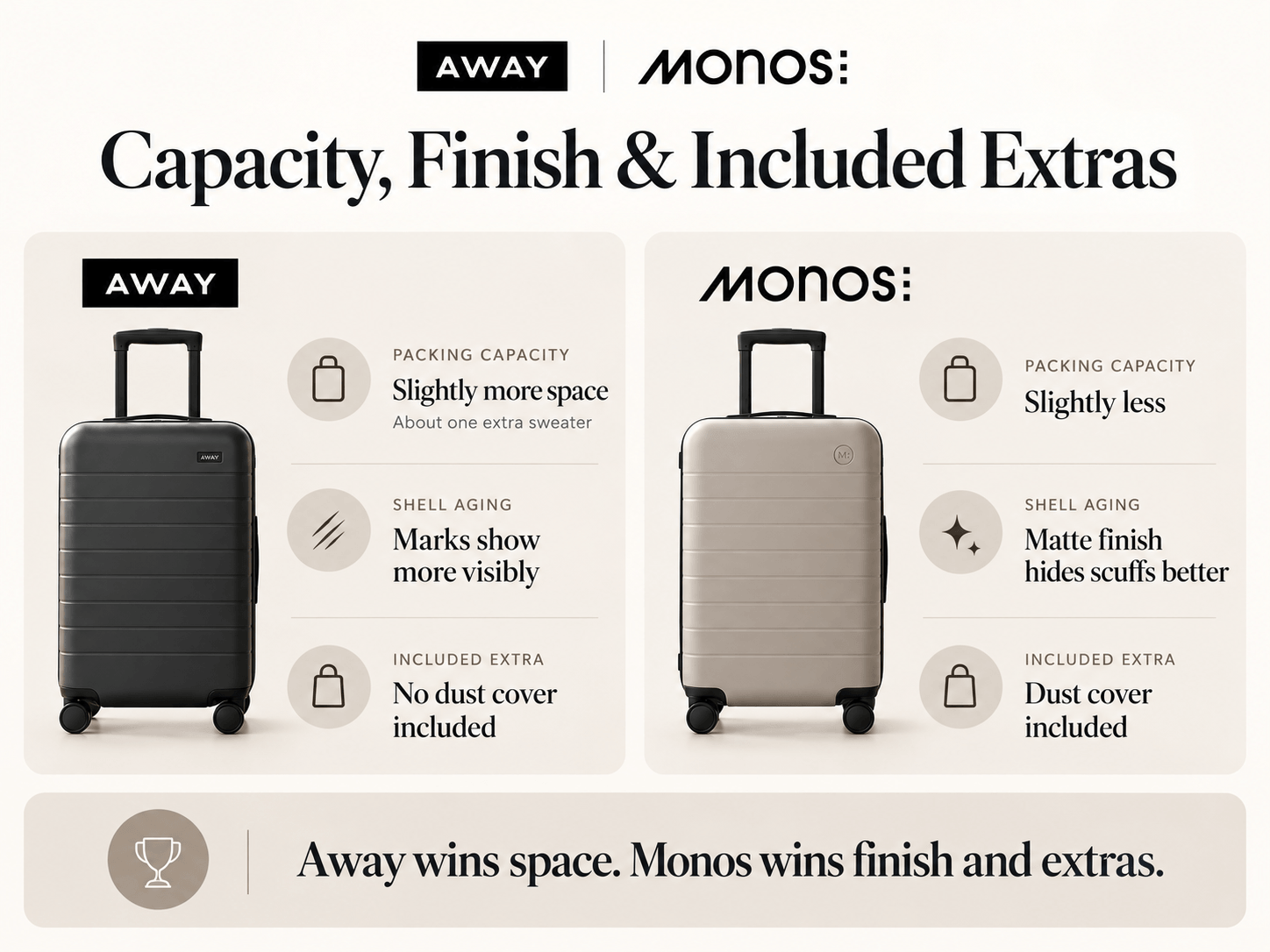
Same external footprint, and the Away held slightly more inside it. Roughly one extra sweater worth of space across identical packing lists.
Both fit overhead bins on every flight we took without a fight. Neither has an organisational advantage, since the interiors are laid out the same way.
The gap is real but small. If you pack light it will never matter. If you routinely stuff a carry on to the zip, you will notice it.
Winner: Away
Small margin, but a genuine one in the same footprint.
Difference 2: How the Shell Ages
Both shells picked up marks, which is unavoidable on any hard sided bag that goes through an airport.
By flight three, the Away showed visible scuffing along the bottom edge and corners, particularly after cobblestone. Some were wiped off with a damp cloth. Some did not.
The Monos held up better over the same trips, and its matte finish hid marks more effectively than Away’s finish did.
Same material, different finish, clearly different result after four months.
Winner: Monos
Same polycarbonate, better finish, visibly better condition at the end.
Difference 3: The Wheels
This is where two identical bags stopped being identical.
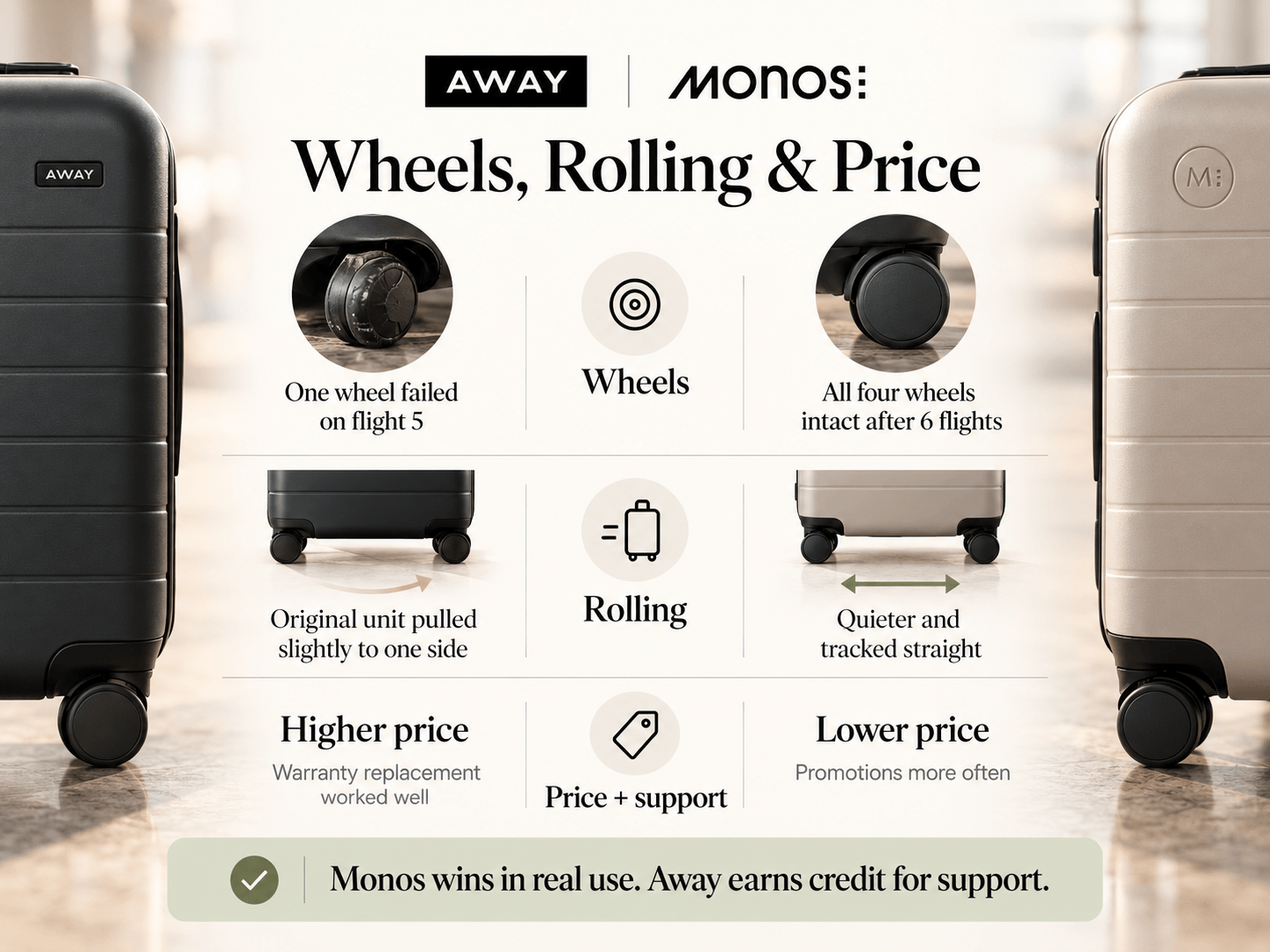
On flight five, the Away’s rear left wheel developed a wobble during a long push across a rough terminal floor. By the end of that trip it had seized completely and no longer rotated, so we dragged the bag for two days.
The Monos wheels were still turning smoothly after six flights with no wobble on any of the four.
Both bags use four spinner wheels of the same general type. One set survived and one did not.
To be fair about what this is, a single failure is not a pattern and we are reporting what happened rather than declaring Away’s wheels defective. But it happened after five flights, and it happened to the more expensive bag.
Winner: Monos
Six flights, four working wheels, no incident.
Difference 4: How They Roll
Both handles felt solid when extended with minimal wobble, and neither developed play across the test.
Rolling was where they separated. The Monos ran quieter on smooth terminal floors and tracked straight when pushed at speed alongside us.
The original Away pulled slightly to one side from the first flight, before the wheel issue appeared. The replacement bag rolled straight, which suggests that pull was a defect in that specific unit rather than a design trait.
Winner: Monos
Quieter and straighter, consistently, across identical hardware.
Difference 5: What Is in the Box
Monos includes a dust cover. Away does not.
Small thing. We used it for storage between trips and the bag stayed noticeably cleaner as a result, which contributed directly to the finish difference above.
Away sells accessories separately. Monos bundles this one.
Winner: Monos
Included rather than sold separately.
Difference 6: Price and What Happened After
Away generally sits higher at retail. Monos undercuts it and runs promotions more often.
We did file a warranty claim with Away for the failed wheel. Entirely online, photos required, no phone call, approved without argument, replacement arrived in about three weeks at no cost. That is a genuinely good outcome and it says something real about the company.
We never needed to test Monos’s warranty, which is either good luck or a good sign depending on how you read it.
Winner: Monos on price, Away on support
Cheaper bag, but the pricier one proved it stands behind the product.
Which One Should You Choose?
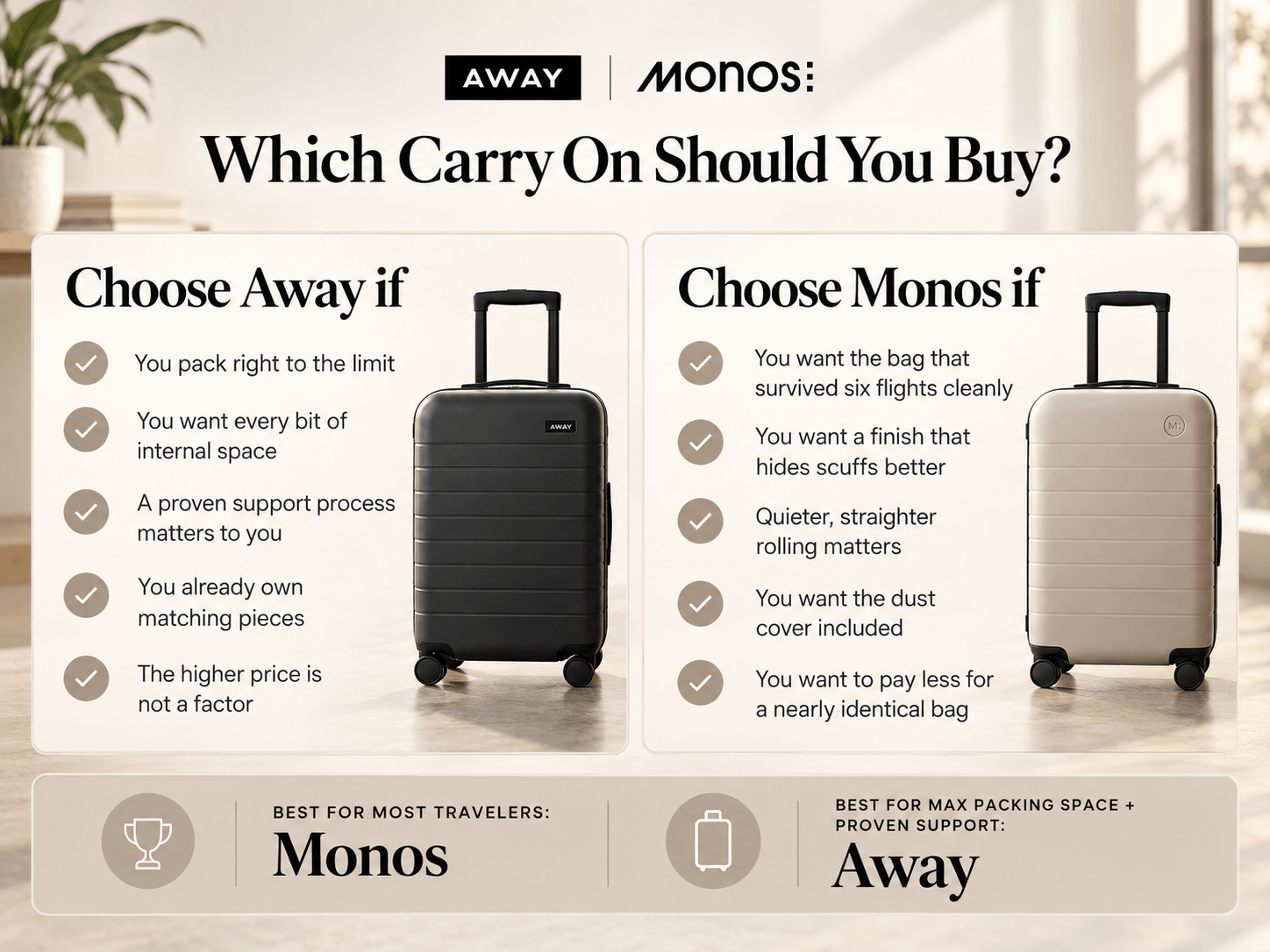
Choose Away if:
- You pack a carry on to its absolute limit and need every inch.
- You want a support process that has been tested and works.
- You prefer their specific colour and finish options.
- You already own matching pieces from the same line.
- The higher price is not a factor for you.
Choose Monos if:
- You want the bag that survived six flights untouched.
- You want a finish that hides scuffs on the same material.
- Quieter, straighter rolling matters on long terminal walks.
- You want the dust cover included rather than bought separately.
- You want to pay less for a nearly identical specification.
Final Verdict
When two products match on seven specifications, the six differences decide everything.
Away won one of those six on packing capacity and split another on warranty support. Both are legitimate reasons to buy it, and it is not a bad bag.
Monos won four outright. Better finish on identical material, wheels that survived when the other set did not, straighter and quieter rolling, a dust cover in the box, and a lower price.
Same shell, same wheels, same handle, same interior. One of them came home working and one of them did not.
For most travelers, Monos is the better all around carry on.
For anyone who packs to the limit and values a proven support process, Away remains a reasonable choice.