
Cordless vacuums get judged on suction numbers in the store and on runtime in the reviews. Neither one tells you much after week three.
What actually decides whether a cordless vacuum stays on the wall mount or ends up in a closet is how many small annoyances it creates. Emptying the bin. Cleaning the brush roll. Remembering to charge it. Whether it stands up on its own.
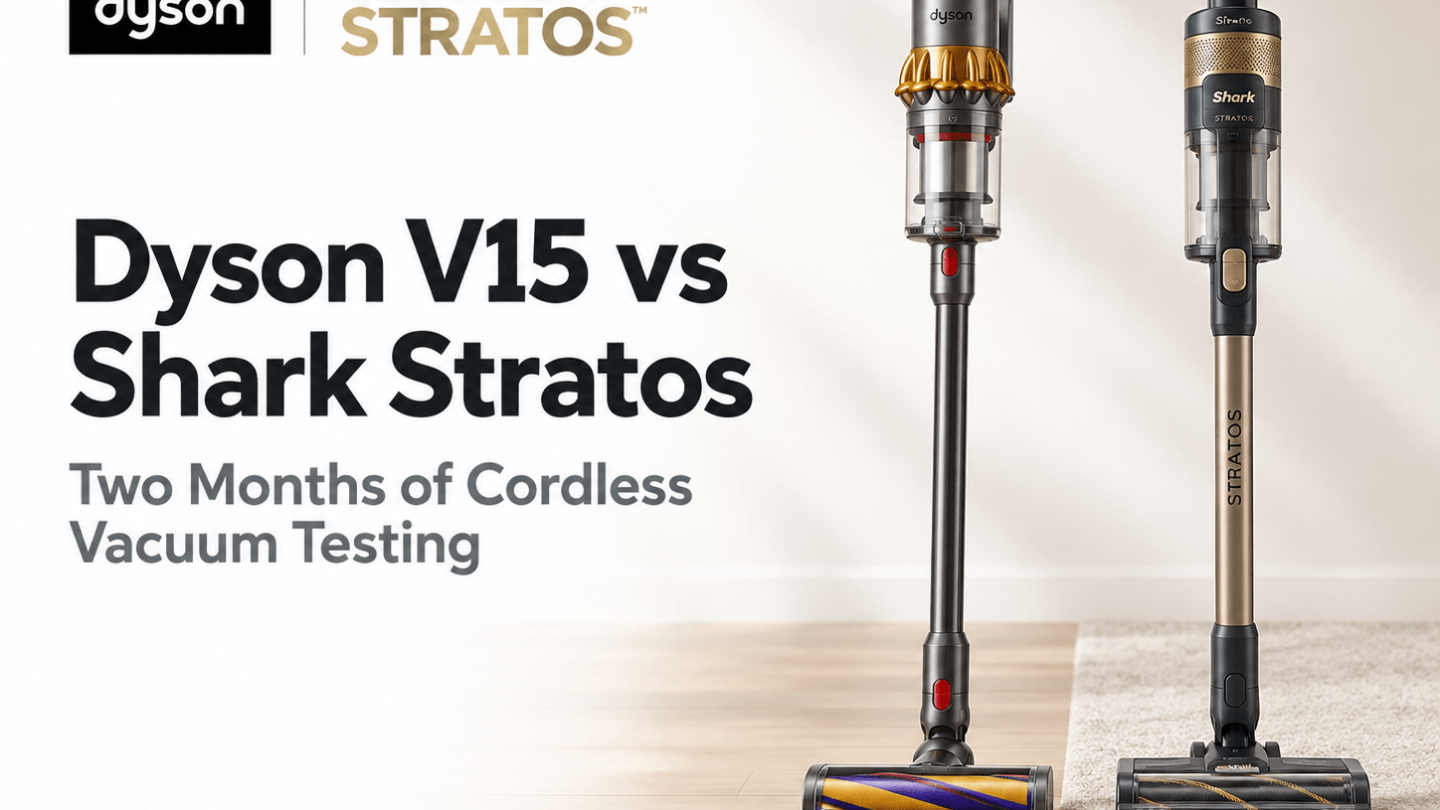
We used a Dyson V15 and a Shark Stratos on alternating weeks for two months in a home with two shedding pets, hard floors in the main areas, and carpet in two bedrooms.
Quick Comparison
| What We Checked | Dyson V15 | Shark Stratos |
| Runtime on standard mode | About 50 minutes | About 45 minutes |
| Runtime on max mode | Under 12 minutes | Under 12 minutes |
| Hair wrapping on brush roll | Almost none | Almost none |
| Bin emptying | Lever, mostly clean | Lever, mostly clean |
| Stands on its own | No | Yes |
| Weight in hand | Lighter | Heavier |
| Onboard display | Particle count screen | Simpler status screen |
Cleaning Performance on Hard Floors
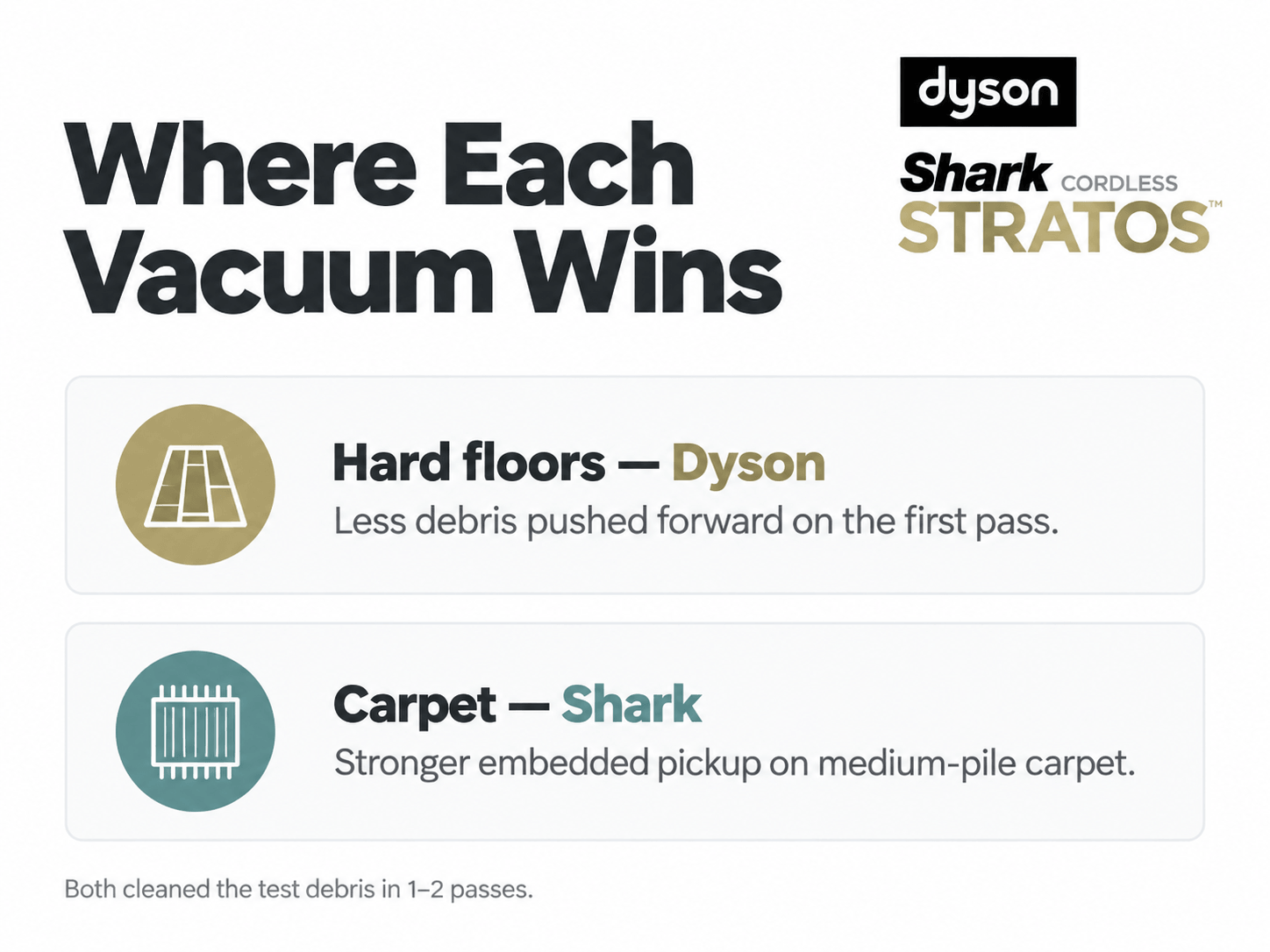
Both picked up everything we put in front of them. Flour, oats, coffee grounds, pet hair, and general daily debris all came up in one or two passes on either machine.
The Dyson’s fluffy hard floor head threw slightly less debris ahead of itself on first contact, which meant fewer chase down passes on scattered dry material. Small advantage, but we noticed it repeatedly.
The Shark’s head was a little wider, so full room passes took fewer strokes.
Honestly, on hard floors these are close enough that either will keep a house clean.
Winner: Dyson. Narrowly, on first pass pickup.
Cleaning Performance on Carpet
The Shark did better here in our testing, particularly on the medium pile bedroom carpet. It pulled more embedded material out on the second and third passes and left more visible track lines, which is a rough proxy for agitation depth.
The Dyson performed well but needed max mode more often on carpet to feel equivalent, and max mode drains the battery fast on both machines.
Winner: Shark.
Hair Tangling
This was the biggest surprise of the test. Neither one tangled.
Both use anti tangle brush roll designs, and across two months in a house with two shedding pets we cut hair off a roller exactly zero times. Anyone who used a cordless vacuum five or six years ago will understand what a change that is.
If tangled hair is your main complaint with your current vacuum, either of these solves it.
Winner: Tie.
Battery and Runtime
Advertised numbers on cordless vacuums assume standard mode with a non powered attachment. Nobody vacuums that way.
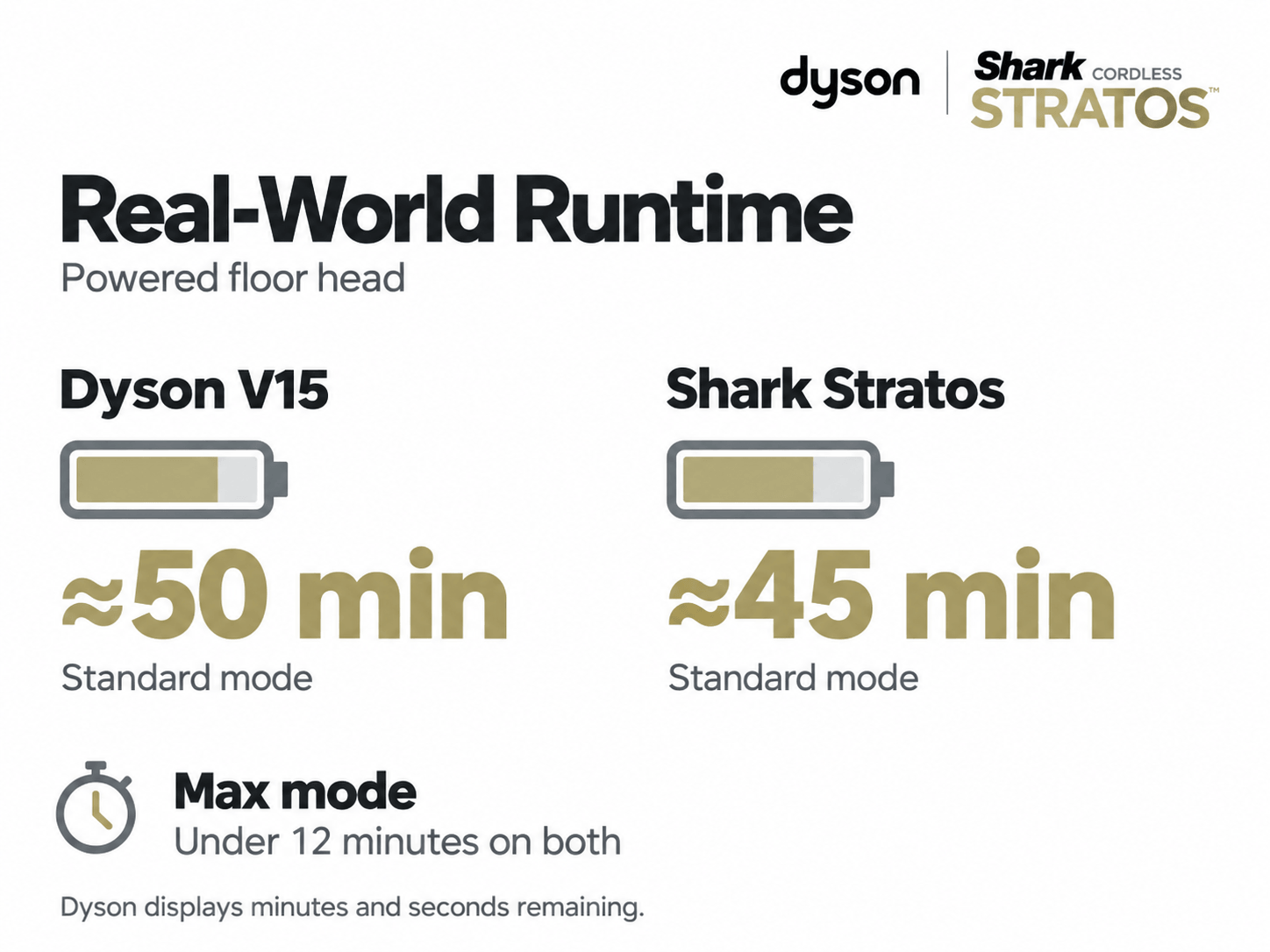
In real use with the powered floor head, the Dyson gave us around fifty minutes on standard and under twelve on max. The Shark gave us around forty five on standard and roughly the same under twelve on max.
Both cover a normal apartment or a floor of a house on standard. Neither covers a whole home on max, and you should not plan to use max continuously anyway.
The Dyson’s screen shows remaining runtime in actual minutes and seconds, which is more useful than a battery bar. That is a small feature that changed how we used the machine, because we could see whether a room would fit in the remaining charge.
Winner: Dyson.
Emptying and Filter Maintenance
Both bins empty with a lever and both do it reasonably cleanly. Neither is perfect. Fine dust puffs back at you on both if you empty them too fast over an open trash can.
Filter care is where the routine differs. Both filters are washable and both need to be fully dry before going back in, which means you lose the vacuum for a day when you wash one. We washed each filter twice over the two months.
The Shark’s filter came out slightly easier to access. The Dyson’s twists out cleanly too but sits deeper in the body.
Winner: Shark. Marginally.
Handling and Storage
The Shark stands up on its own. The Dyson does not.
That sounds trivial. It is not. Being able to let go of the vacuum mid room to move a chair, answer the door, or pick something up off the floor changed how often we used it. The Dyson has to be leaned against a wall or laid down, and both feel awkward.
The Dyson is the lighter machine in hand, and over a long session that matters for wrist fatigue. So there is a real tradeoff here rather than a clean win.
Winner: Shark on convenience. Dyson on weight.
Noise
The Dyson was the quieter machine on standard mode in our testing. Both are loud on max and neither is pleasant at that setting.
Winner: Dyson.
Price and Ongoing Cost
The Dyson carries the higher price at retail and its replacement filters and attachments cost more too. The Shark undercuts it meaningfully at purchase and on parts.
Both companies sell replacement batteries, which matters more than most buyers realize. A cordless vacuum’s real lifespan is decided by whether you can swap the battery in year four rather than replace the whole machine.
Winner: Shark on value.
Choose the Dyson V15 If
- You want the lighter machine for longer sessions.
- Mostly hard floors with some carpet.
- You want the runtime display and particle count screen.
- Quieter operation on standard mode matters at home.
Choose the Shark Stratos If
- You have a lot of medium or high pile carpet.
- You want a vacuum that stands on its own between tasks.
- You want to spend less at purchase and on replacement parts.
- Filter access and easy maintenance matter to you.
Final Verdict
The Dyson V15 is the better engineered machine. Lighter, quieter, better hard floor pickup, and the runtime display genuinely changes how you use it.
The Shark Stratos is the one we reached for more often. Standing on its own is the reason. Over two months, that single design choice removed more friction from daily cleaning than any specification on the Dyson added.
If you have mostly hard floors and value the lighter build, buy the Dyson. If you have carpet and want the vacuum that gets used without thinking about it, buy the Shark and put the price difference toward a second battery.
We will update this comparison if either brand releases a meaningfully revised model.